
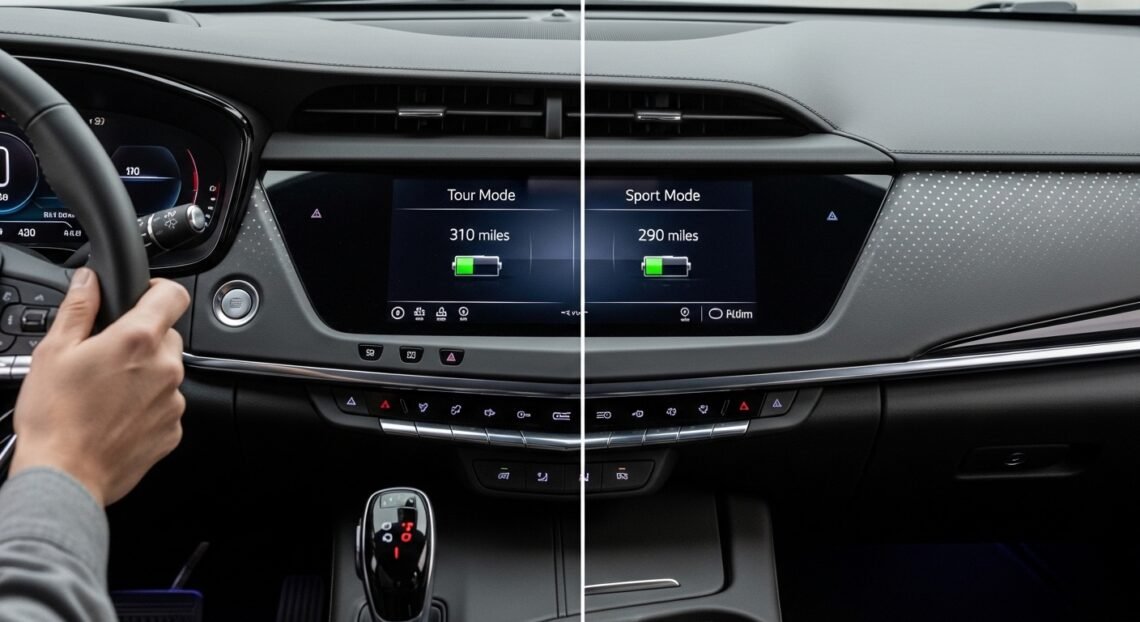
If you are considering a Cadillac LYRIQ, one question is easy to ask but surprisingly difficult to answer: Do the different driving modes change how far the LYRIQ can travel on a single charge?
The short answer is yes, but indirectly.
Selecting a driving mode does not change the physical capacity of the battery. Instead, it changes how the LYRIQ responds to the accelerator, steering inputs, suspension settings, traction management, and other vehicle systems. Those changes can influence how much energy you use during a trip.
However, it is important not to overstate the effect. There is no universal percentage of range that you lose simply by selecting Sport mode, because your actual consumption depends on how you drive and where you drive. Highway speed, temperature, wind, elevation, tire selection, cabin heating or cooling, traffic, and acceleration can all have a substantial effect.
That distinction is useful for everyday LYRIQ ownership. Rather than treating one driving mode as a magic “range mode,” it is better to understand what each mode does and then match it to the conditions.
The Cadillac LYRIQ Battery: What Actually Changes?
The first thing to understand is that a driving mode does not physically increase or decrease the battery’s stored capacity.
The LYRIQ uses General Motors’ Ultium EV architecture, with battery capacity and configuration varying by model year, trim, and drivetrain. That means you should always check the specifications for the particular LYRIQ you are considering rather than assuming every version has exactly the same usable battery capacity or EPA range.
This matters because published range figures can also vary between:
- Model years
- Rear-wheel-drive and all-wheel-drive versions
- Wheel and tire configurations
- Trim levels
- Testing procedures and software updates
The EPA range figure is a standardized comparison number, not a promise that every driver will achieve the same mileage.
Think of the battery as your fuel tank.
Changing from Tour to Sport does not make the tank smaller. Instead, the selected mode can influence how aggressively the vehicle delivers its stored energy.
That is why the better question is not:
“Does Sport mode reduce battery capacity?”
It is:
“Does the way Sport mode changes vehicle behavior cause me to consume energy faster?”
In real-world driving, the answer can certainly be yes.
How Driving Modes Affect EV Energy Consumption
Unlike a conventional gasoline vehicle, an EV can change its driving characteristics substantially through software.
Depending on the LYRIQ configuration and model year, drive-mode settings can influence characteristics such as:
- Accelerator response
- Power delivery
- Steering feel
- Suspension behavior
- Traction control
- Regenerative-braking behavior
- Vehicle response in low-traction conditions
These settings do not alter the battery’s chemistry or physical capacity.
The biggest practical difference usually comes from the driver’s right foot.
Suppose two drivers leave with the same state of charge.
Driver A uses gentle acceleration, anticipates traffic, maintains a reasonable speed, and avoids unnecessary braking.
Driver B repeatedly accelerates hard because Sport mode makes the accelerator feel more immediate.
Even if both drivers use the same LYRIQ and start with the same battery percentage, Driver B can consume considerably more energy.
This is why driving mode and driving style should not be treated as separate subjects.
Tour Mode: The Sensible Everyday Choice
Tour is generally the natural starting point for everyday LYRIQ driving.
Its character is designed around smooth, predictable operation rather than maximum driver involvement. For commuting, errands, and long-distance travel, that can make it easier to drive consistently.
The important point is that Tour mode does not magically create additional electricity.
Instead, its calmer response can make it easier to avoid unnecessary energy consumption.
For example, imagine you are approaching a highway on-ramp.
A very aggressive accelerator input creates a large demand for power. A smooth increase in speed generally requires less energy than repeatedly accelerating and backing off.
The same principle applies in city traffic.
If the vehicle responds predictably, it becomes easier to make small accelerator adjustments rather than repeatedly demanding large bursts of power.
Is Tour Mode the Best for Maximum Range?
For most drivers, Tour is a sensible choice when efficiency is the priority, but it should not be treated as a guaranteed range-maximizing setting.
Your driving technique still matters more than the mode name.
A smooth driver in Sport can sometimes use less energy than an aggressive driver in Tour.
That is one of the most important practical lessons for LYRIQ owners.
Sport Mode: More Response, Potentially More Consumption
Sport mode changes the personality of the LYRIQ.
The accelerator can feel more responsive, steering can feel more substantial, and the vehicle can feel more eager when you request acceleration.
That can be enjoyable, particularly on winding roads or when you want more immediate performance.
But there is a trade-off.
The LYRIQ’s electric motors can deliver substantial power, and using that performance repeatedly requires energy. The more frequently you make hard accelerations, the faster the battery’s state of charge can fall.
It would be misleading to say that Sport mode always reduces range by a fixed 8%, 10%, or 15%.
There is no universal penalty because the actual difference depends on how the driver uses the mode.
A driver who selects Sport but drives gently may see little difference.
A driver who repeatedly uses strong acceleration can see a much larger difference.
When Sport Mode Makes Sense
Sport mode is appropriate when:
- You value responsiveness over maximum efficiency.
- You are enjoying a back-road drive.
- You want a more engaging accelerator response.
- You do not need to maximize every available mile.
There is no reason to avoid Sport mode simply because you are worried about damaging the battery.
The vehicle’s battery management and thermal-management systems are designed to regulate battery operation within appropriate limits.
The real trade-off is usually energy consumption, not battery health.
Snow/Ice Mode: Safety Comes First
Snow/Ice mode has a completely different purpose.
It is designed for conditions where available traction is limited. Rather than chasing maximum acceleration, the vehicle’s control systems prioritize predictable responses and maintaining grip.
This can be useful on:
- Snow
- Ice
- Slippery roads
- Certain wet conditions
- Low-traction surfaces
It would be a mistake to select Snow/Ice mode simply because you want maximum range.
The purpose of the mode is traction management and control, not creating an efficiency advantage.
And there is another important point: if winter range falls dramatically, the driving mode may not be the primary reason.
Cold temperatures can have a significant effect on EV efficiency because batteries operate less efficiently in cold conditions, while cabin heating and other systems require additional energy.
That means a LYRIQ driver may see a noticeable winter-range reduction even when driving gently in an efficiency-oriented mode.
The Practical Winter Lesson
If the road is slippery, use the mode appropriate for the conditions.
Saving a few miles of estimated range is not worth compromising traction.
If the weather is cold but the roads are dry, focus on the larger factors affecting efficiency:
- Battery temperature
- Cabin heating
- Tire pressure
- Driving speed
- Wind
- Route conditions
My Mode: The Most Interesting Option for Experimentation
My Mode is particularly useful for drivers who want to personalize the LYRIQ rather than simply select a preset.
Depending on the vehicle configuration and available settings, My Mode can allow you to customize aspects of the driving experience.
This creates an interesting opportunity for efficiency-conscious drivers.
You can build a profile around smooth accelerator response and the characteristics you personally find easiest to drive efficiently.
But there is an important misconception to avoid:
More regenerative braking does not automatically mean more total range.
Regenerative braking recovers some of the vehicle’s kinetic energy when the vehicle slows down. That is useful because some of that energy would otherwise be dissipated through conventional friction brakes.
But regeneration is not 100% efficient.
Energy is lost as it moves through the motor, power electronics, battery, and other components.
So deliberately accelerating just to recover energy through regenerative braking is not an efficient strategy.
The most efficient approach is generally to avoid unnecessary acceleration in the first place.
Regenerative Braking: Where Drivers Often Get Confused
Regeneration is one of the most misunderstood parts of EV efficiency.
When you slow down using regenerative braking, the electric motor can operate as a generator. Some of the vehicle’s kinetic energy is converted back into electrical energy and stored in the battery.
That is valuable.
But consider two driving styles.
Driver One
The driver anticipates a red light early and gradually reduces speed.
Driver Two
The driver accelerates toward the light and then uses heavy regenerative braking to stop.
Driver Two may see energy returned to the battery, but that does not mean the extra acceleration was free.
The best efficiency usually comes from minimizing unnecessary energy conversion in the first place.
The LYRIQ’s regenerative-braking controls can still be extremely useful, particularly in city traffic and situations where frequent slowing is unavoidable.
The goal is not to avoid regeneration.
The goal is to use it intelligently.
One-Pedal Driving and Everyday Efficiency
One-pedal driving can make urban driving particularly intuitive for some EV owners.
Instead of repeatedly moving between accelerator and brake pedal, the driver can modulate the accelerator to control acceleration and deceleration.
When the accelerator is released, regenerative braking can slow the vehicle.
This can reduce reliance on the friction brakes and make stop-and-go traffic easier to manage.
But once again, the biggest efficiency advantage comes from anticipation.
If you can see traffic slowing ahead, gradually reducing speed is generally preferable to accelerating until the last possible moment and then braking hard.
After a few days, many EV drivers naturally develop this habit.
Why Speed Often Matters More Than Driving Mode
This is one of the most important points when discussing LYRIQ range.
At highway speeds, aerodynamic drag becomes a major factor in energy consumption.
As speed increases, the amount of energy required to push the vehicle through the air rises rapidly.
That means a driver who reduces highway speed moderately can sometimes make a much larger difference to consumption than someone who simply switches between Tour and Sport.
Consider two hypothetical LYRIQ drivers:
Driver A: Tour mode, high highway speed, frequent hard acceleration.
Driver B: Sport mode, moderate speed, smooth acceleration.
Driver B could potentially achieve better efficiency despite using Sport.
This illustrates why driving mode should never be considered in isolation.
Real-World LYRIQ Range Is More Complicated Than the EPA Number
EPA range estimates are extremely useful because they give consumers a standardized way to compare vehicles.
But your LYRIQ does not know that it is supposed to achieve the number printed on a specification sheet.
Real-world energy consumption changes constantly.
Temperature
Cold weather can reduce EV efficiency and increase heating demand.
HVAC Use
Heating and air conditioning consume electricity.
Highway Speed
Higher speeds generally increase aerodynamic losses.
Wind
A strong headwind can significantly increase the energy required to maintain speed.
Hills
Climbing requires additional energy. Descending can recover some energy through regeneration, but not necessarily all of the energy used to climb.
Tires
Tire type, pressure, temperature, and rolling resistance can influence efficiency.
Wheels
Larger wheel and tire packages can sometimes reduce efficiency because of weight and rolling resistance.
Passenger and Cargo Weight
A heavily loaded vehicle requires more energy, particularly during acceleration and climbing.
Driving Style
This remains one of the biggest variables under the driver’s direct control.
What Mode Should You Use for Maximum Range?
For most everyday situations, start with Tour mode.
Then concentrate on the factors that actually make the largest difference.
For the best practical efficiency:
- Accelerate smoothly.
- Avoid unnecessary high speeds.
- Anticipate traffic.
- Maintain appropriate tire pressure.
- Use regenerative braking intelligently.
- Avoid carrying unnecessary weight.
- Precondition the cabin when practical while the vehicle is connected to a charger.
- Consider weather and wind when planning longer trips.
- Use Snow/Ice mode when traction requires it.
- Save Sport mode for situations where its performance is worth the additional energy consumption.
If you enjoy customizing your vehicle, My Mode can also be worth experimenting with.
But do not assume that the most aggressive regenerative-braking setting automatically produces the best possible range.
A Simple Way to Test Your Own LYRIQ
If you want to know whether a driving mode actually makes a meaningful difference for your LYRIQ, you can conduct a simple comparison.
Choose a familiar route.
Keep as many variables consistent as possible:
- Similar outside temperature
- Similar tire pressures
- Similar traffic conditions
- Similar HVAC settings
- Similar vehicle load
- Similar average speed
Drive the route once in Tour and once in Sport.
Do not compare only the estimated miles remaining on the dashboard. Instead, look at the vehicle’s energy-consumption information and compare the actual efficiency over multiple trips.
One trip is not enough.
Wind, traffic lights, temperature, and elevation can easily distort the result.
A better test uses several drives in each mode.
This is a much more reliable way to determine whether a particular setting makes a meaningful difference for your driving style.
Common Mistakes LYRIQ Owners Should Avoid
Assuming Sport Mode Has a Fixed Range Penalty
There is no universal percentage.
The driver’s behavior determines much of the difference.
Blaming Snow/Ice Mode for Winter Range Loss
Cold temperatures and cabin heating can be much more significant factors.
Thinking Regeneration Creates Free Energy
Regeneration recovers energy that would otherwise be lost, but it cannot recover all the energy previously used to accelerate.
Driving Slowly Only to Chase Range
Extremely slow driving is not always practical or safe. Efficient driving is about sensible speed, smooth inputs, and planning.
Relying Completely on the Range Estimate
The dashboard estimate is useful, but conditions continuously change.
Assuming Every LYRIQ Has Identical Specifications
Battery configuration, drivetrain, model year, trim, wheels, and other equipment can affect official specifications and real-world efficiency.
So, Do Cadillac LYRIQ Driving Modes Really Change Range?
Yes, but the effect is indirect and highly dependent on driving conditions.
The driving mode can change how the LYRIQ responds, which can influence energy consumption. Sport mode can encourage stronger acceleration and therefore higher consumption, while Tour generally provides a smoother everyday driving experience.
Snow/Ice mode prioritizes traction rather than range.
My Mode allows more personalization, but its efficiency depends on how it is configured and how you drive.
The crucial point is that the selected mode is only one part of the energy equation.
Highway speed, temperature, HVAC use, tires, wind, terrain, traffic, vehicle load, and acceleration can all matter substantially.
FAQ
Does Sport Mode reduce Cadillac LYRIQ range?
It can, particularly when Sport mode encourages frequent hard acceleration and higher power demand. However, there is no fixed percentage of range lost simply because Sport mode is selected. A smooth driver may see a relatively small difference, while aggressive driving can increase energy consumption considerably.
Which Cadillac LYRIQ driving mode is best for range?
Tour is the best starting point for most drivers who want a comfortable and predictable driving experience with an emphasis on efficiency. However, driving smoothly at moderate speeds is more important than simply selecting Tour. My Mode can also be useful if its settings are configured around your driving habits.
Does regenerative braking increase LYRIQ range?
Regenerative braking can improve efficiency by recovering some kinetic energy that would otherwise be lost during deceleration. However, regeneration is not perfectly efficient, so it does not replace energy used during acceleration. The best strategy is to anticipate traffic and avoid unnecessary acceleration and braking whenever possible.
Does Snow/Ice Mode reduce LYRIQ range?
Snow/Ice mode is designed primarily to improve control and traction on slippery surfaces, not to maximize range. If your LYRIQ experiences significantly lower range during winter, cold temperatures, cabin heating, road conditions, and reduced battery efficiency may have a much larger effect than the selected mode.
Can driving mode damage the LYRIQ battery?
Normal factory-provided driving modes are designed to operate within the vehicle’s intended operating limits. Sport mode can increase energy consumption because it makes performance easier to access, but selecting it does not inherently mean you are damaging the battery. The vehicle’s battery-management and thermal-management systems are designed to monitor operating conditions.
Conclusion
The Cadillac LYRIQ’s driving modes are more than simple labels such as “comfortable,” “sporty,” or “snow.”
They change the way the vehicle responds to the driver, and that can influence how efficiently the stored battery energy is used. But the mode itself does not change the physical size of the battery or magically add or remove miles from its capacity.
For everyday driving, Tour mode is the sensible starting point. Sport mode is there when you want stronger responses and a more engaging drive, while Snow/Ice mode should be selected when traction and stability are more important than efficiency. My Mode is the most interesting option for drivers who want to personalize the vehicle and experiment with different settings.
The bigger lesson is that range management starts with driving behavior.
Smooth acceleration, sensible highway speeds, anticipating traffic, correct tire pressure, appropriate climate-control use, and thoughtful use of regenerative braking can matter as much as—or more than—the mode shown on the dashboard.
So if you are trying to get the most miles from your LYRIQ, do not obsess over finding one perfect setting.
Choose the mode that fits the conditions, then focus on how you drive.