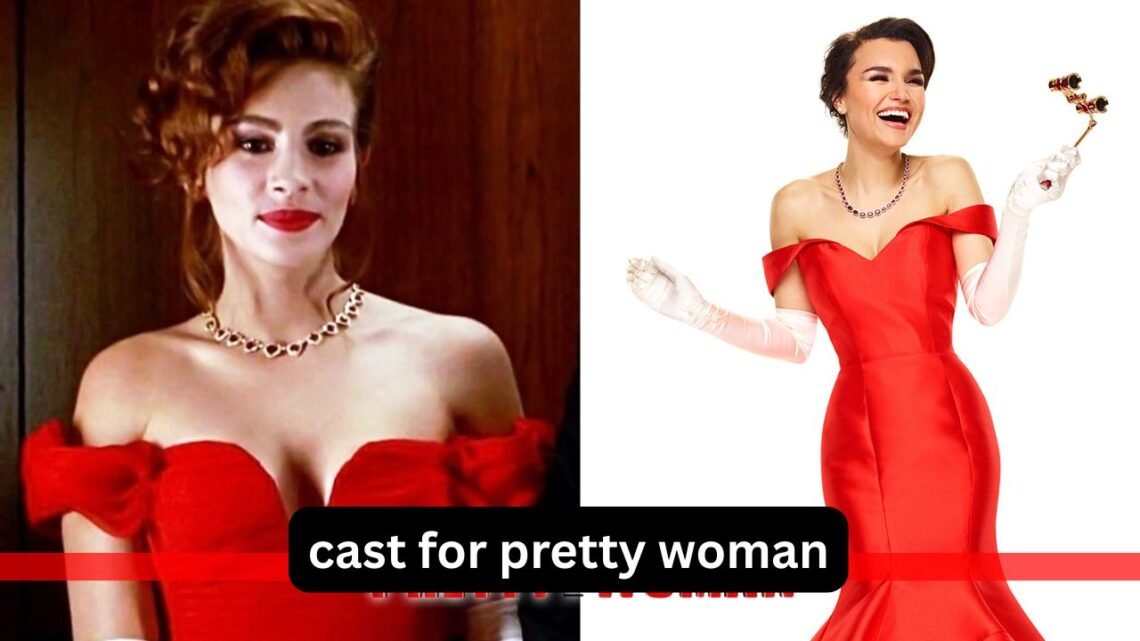
If you search for the cast for Pretty Woman, it is easy to find Julia Roberts and Richard Gere and assume they were always the obvious choices. They were not. The casting history of Pretty Woman is surprisingly complicated, and the answer becomes even more interesting when you include the London stage musical.
For the 1990 film, Julia Roberts eventually became Vivian Ward, but several established actresses were considered, auditioned, or offered the part before Roberts secured it. Diane Lane came particularly close, while Molly Ringwald and Meg Ryan were among the better-known names associated with the role.
There is also a separate London connection. In the West End production of Pretty Woman – The Musical, Elly Jay was originally cast as a swing and second cover for Vivian before unexpectedly stepping into the lead when other performers were unavailable.
So, who was originally cast, who turned the role down, and who actually played the main characters? Here is the full story.
Who was originally cast in Pretty Woman?
The short answer depends on what you mean by “originally cast.”
For the 1990 movie, Julia Roberts was not the first actress considered for Vivian Ward. Garry Marshall initially envisioned other actresses, and a long list of performers were approached or auditioned before Roberts ultimately won the part.
For the London musical, the situation is different. Elly Jay was originally hired as a swing and second cover for Vivian rather than as the principal Vivian. She later had the opportunity to perform the lead unexpectedly.
That distinction matters because “originally cast” can refer to two completely different production histories.
Who played Vivian Ward in the 1990 film?
Julia Roberts played Vivian Ward in the 1990 film, opposite Richard Gere as Edward Lewis. The principal cast also included Laura San Giacomo as Kit De Luca, Jason Alexander as Philip Stuckey, Héctor Elizondo as Barney Thompson and Ralph Bellamy as James Morse.
Roberts was only 21 when she took the role, and Pretty Woman became the performance that transformed her into a major Hollywood star.
What makes the casting story unusual is that Roberts was not simply handed the part after one audition. The project itself changed dramatically during development, and her position in the production changed along with it.
The screenplay was originally titled 3,000 and was conceived as a considerably darker story rather than the romantic comedy audiences eventually saw. The American Film Institute records the original title and its connection to the $3,000 arrangement between Vivian and Edward.
Why the original casting was so difficult
The early version of the story was much grittier. That affected how actors viewed Vivian.
The role was not initially presented as the glamorous romantic-comedy character that audiences now associate with Julia Roberts. The original concept dealt more directly with prostitution, poverty and exploitation.
That is one reason several actresses reportedly rejected or hesitated over the role.
Was Diane Lane originally cast as Vivian?
Diane Lane is one of the most important names in the casting history because she reportedly came extremely close to playing Vivian.
Some accounts describe Lane as having been cast or effectively attached to the role during an earlier version of the production. She even went through costume-related preparations, but scheduling problems prevented her from ultimately making the film.
This is an important distinction from simply saying that she “auditioned.”
An actress can be:
- considered for a role,
- invited to audition,
- offered the role,
- attached to a project,
- or formally cast and later replaced.
Those are not interchangeable terms.
In Lane’s case, the story is particularly interesting because the movie was still evolving. The darker version of Vivian’s story was substantially different from the finished romantic comedy.
Did Molly Ringwald turn down Pretty Woman?
Yes. Molly Ringwald was among the prominent actresses considered for Vivian Ward, but she declined the role.
Ringwald later explained that she did not feel comfortable with the story and thought there was something troubling about it. Her decision became famous in retrospect because Pretty Woman went on to become one of the defining romantic comedies of the 1990s.
This is one of the most useful lessons from the film’s casting history: a role that looks perfect in hindsight may have looked very different during development.
Actors were reacting to the script they were actually offered—not to the finished movie everyone knows today.
Did Meg Ryan turn down the role?
Meg Ryan was another major name associated with Vivian Ward.
She was reportedly one of the studio and Garry Marshall’s preferred choices, but she did not take the role.
Ryan’s career was already developing rapidly, and the material did not necessarily fit the image audiences later associated with the finished film.
Had Ryan accepted, Pretty Woman would have had a completely different identity. Her performance style was distinct from Roberts’, and the chemistry with whoever played Edward Lewis would inevitably have changed the movie.
Which other actresses were considered for Vivian?
The list is much longer than most viewers realize.
Among the actresses associated with the role during the casting process were:
- Molly Ringwald
- Meg Ryan
- Michelle Pfeiffer
- Daryl Hannah
- Diane Lane
- Winona Ryder
- Jennifer Connelly
- Patricia Arquette
- Drew Barrymore
- Brooke Shields
- Uma Thurman
- Kristin Davis
- Rebecca Schaeffer
Different sources describe some of these women as having auditioned, been considered, or been offered the role, so it is important not to treat every name as having reached exactly the same stage of casting.
Winona Ryder and Jennifer Connelly, for example, were considered too young for the part at the time. Emily Lloyd turned down the role because of a scheduling conflict involving Mermaids.
That makes the eventual casting of Roberts even more remarkable.
Why Julia Roberts almost did not become Vivian
There is another twist that is often overlooked.
Roberts did get the role during an earlier stage of development, but the project later went through a major production-company change. The original company, Vestron Pictures, collapsed, and Roberts temporarily lost her place in the project.
According to accounts of the production, the actress had already been attached when the company went out of business. When the project was revived under a different setup, she had to effectively win the role again.
Garry Marshall ultimately helped bring Roberts back into the production.
This means the casting story was not simply:
Actress A → Actress B → Julia Roberts.
It was closer to:
early concept → changing actresses → Roberts → production collapse → recasting discussions → Roberts returns → finished film.
That complicated path is a major reason the movie’s casting history remains so interesting.
Who was originally considered for Edward Lewis?
Richard Gere also was not the inevitable choice for Edward Lewis.
The production considered several actors during development. Christopher Reeve, Al Pacino, Daniel Day-Lewis and Denzel Washington have all been associated with the casting discussions, although the exact level of consideration varied.
Gere eventually became the perfect counterpart to Roberts because Edward needed to be sophisticated and emotionally restrained without making the character completely cold.
The chemistry between Gere and Roberts became one of the film’s biggest strengths.
Interestingly, Gere was initially reluctant about the project. Garry Marshall reportedly had to work to persuade him to accept Edward.
What was the original Pretty Woman story like?
This is arguably the biggest casting insight of all.
The film audiences know today was not the movie originally written.
J.F. Lawton’s screenplay was initially called 3,000. It was intended as a darker story about prostitution and economic desperation rather than a glossy romantic fairy tale.
In the earlier concept, Vivian’s relationship with Edward was not necessarily heading toward a happy ending.
The transformation from dark drama to romantic comedy changed the entire casting equation.
An actress who rejected the early script was not necessarily rejecting the version of Pretty Woman that audiences eventually loved.
The original ending was especially dark
The original story reportedly ended with Edward abandoning Vivian after their arrangement ended.
Instead of the famous romantic ending in which Edward climbs Vivian’s fire escape, the earlier concept was much more pessimistic. Roberts and other cast members have discussed how dramatically the story changed during development.
That explains why some actresses viewed the role as uncomfortable or degrading.
It also explains why casting information from different periods can appear contradictory.
What about Pretty Woman in London?
The phrase “Pretty Woman London cast” usually refers to Pretty Woman – The Musical, which transferred to London’s West End after its earlier production.
The London production opened with Aimie Atkinson as Vivian Ward and Danny Mac as Edward Lewis. Official London Theatre announced them as the leads for the West End production, with Atkinson taking the role made famous by Julia Roberts.
So the main London stage pairing was:
| Character | West End performer |
|---|---|
| Vivian Ward | Aimie Atkinson |
| Edward Lewis | Danny Mac |
| Kit De Luca | Jessica Crouch |
| Philip Stuckey | Matthew Stocke |
The musical itself originated on Broadway, where Samantha Barks played Vivian in the original production.
Who was Elly Jay in the London Pretty Woman cast?
Elly Jay provides one of the most unusual casting stories connected with the London production.
She was originally cast as a swing and second cover for Vivian, not as the principal performer.
A swing is particularly important in musical theatre because the performer can step into an ensemble role when another cast member is unavailable. A cover can also be prepared to take over a specific role.
Jay therefore had to know Vivian’s material even though she was not the main Vivian.
Then, only a few days into her West End debut, circumstances changed.
The lead performer and first cover both lost their voices during a period when illness was circulating through the company. Jay was called and asked whether she could perform Vivian that night.
She said yes.
She ended up performing Vivian four times that week.
Why Elly Jay’s story matters
This is a useful real-world example of why “cast” does not always mean “the person whose name appears first on the poster.”
In professional theatre, understudies, covers and swings are trained to be ready for exactly this kind of situation.
Jay already knew the role well enough to step in because she had prepared it before an emergency occurred.
Later, she became first cover and was scheduled to play Vivian for a longer period when the principal performer had other contractual commitments.
Film cast vs London musical cast
The easiest way to understand the different versions is to separate them.
1990 film
The iconic movie featured:
- Julia Roberts — Vivian Ward
- Richard Gere — Edward Lewis
- Laura San Giacomo — Kit De Luca
- Jason Alexander — Philip Stuckey
- Héctor Elizondo — Barney Thompson
- Ralph Bellamy — James Morse
- Alex Hyde-White — David Morse
- Amy Yasbeck — Elizabeth Stuckey
These credits are confirmed by major film databases and the American Film Institute.
London West End musical
The West End adaptation had a different cast, led initially by:
- Aimie Atkinson — Vivian Ward
- Danny Mac — Edward Lewis
The production also featured performers in the supporting roles adapted from the film.
And performers such as Elly Jay could move into the principal role when required.
3 casting facts that are easy to miss
1. Julia Roberts was not the obvious first choice
Today, Vivian Ward is almost inseparable from Roberts. But at the time, filmmakers were considering numerous actresses, and some major stars declined the part.
The lesson is simple: iconic casting often looks inevitable only after the audience has seen the finished performance.
2. The script changed the meaning of the role
The original 3,000 screenplay was darker and more cautionary.
Once the project became a romantic comedy, Vivian’s character—and the emotional expectations surrounding her—changed dramatically.
That is why judging an actress’s decision to reject the role using the finished film can be misleading.
3. London’s Elly Jay story shows the value of preparation
Jay was not initially the headline Vivian in London. She was a swing and second cover.
But because she was prepared, an unexpected opportunity turned into several performances of the lead role.
For performers, this is a powerful practical lesson: the role you are hired to cover can become the role that puts you in front of an audience.
Common mistakes when researching the Pretty Woman cast
There are several reasons online discussions about the casting can become confusing.
Mistake 1: Calling every actress “originally cast.”
Some actresses were considered, some auditioned, some were offered the role, and some were actually attached or cast. Those are different stages.
Mistake 2: Mixing the movie with the musical.
The 1990 film and the London West End musical have completely different casting histories.
Mistake 3: Assuming the original script was the final story.
The early screenplay was considerably darker, so actors were making decisions about a very different project.
Mistake 4: Treating every casting report as equally certain.
Retrospective entertainment articles sometimes compress a complicated process into “X was originally cast.” The strongest answer distinguishes between confirmed credits and reported casting discussions.
FAQ
Who was originally cast for Pretty Woman?
Julia Roberts ultimately played Vivian Ward, but she was not the first actress considered for the role. Molly Ringwald, Meg Ryan, Diane Lane, Michelle Pfeiffer, Daryl Hannah and several others were associated with the casting process. Diane Lane came particularly close to taking the role, while Roberts eventually secured the part after major changes to the production.
Did Diane Lane play Vivian in Pretty Woman?
No. Diane Lane did not appear as Vivian in the finished 1990 film. She was closely associated with an earlier stage of the casting process, but scheduling problems prevented her from ultimately making the movie. Julia Roberts became the finished film’s Vivian Ward.
Who was originally cast for Pretty Woman in London?
If you mean the London West End musical, Elly Jay was originally cast as a swing and second cover for Vivian Ward. She later stepped into the lead unexpectedly when the principal performer and first cover were unavailable. She performed Vivian several times before later becoming first cover.
Who played Vivian in the London Pretty Woman musical?
Aimie Atkinson was announced as the original West End Vivian, with Danny Mac playing Edward Lewis. The musical had previously originated on Broadway with Samantha Barks as Vivian.
Why did actresses turn down Pretty Woman?
The answer partly lies in the original screenplay. Pretty Woman began as a darker project called 3,000, dealing more seriously with prostitution and economic hardship. Some actresses were uncomfortable with the material or its tone, while others had scheduling conflicts or were not selected by the filmmakers.
Was Julia Roberts always going to be Vivian?
No. Roberts was not the first choice, and her position in the project became uncertain when the original production company collapsed. After the project was revived, Garry Marshall helped bring her back, and she ultimately delivered the performance that defined Vivian Ward.
Conclusion
The story behind the cast for Pretty Woman is almost as interesting as the film itself. Julia Roberts became the definitive Vivian Ward, but the role passed through a long list of actresses before the final casting came together. Diane Lane came particularly close, while Molly Ringwald and Meg Ryan were among the prominent names who did not take the part.
The London musical adds another layer. Aimie Atkinson became the original West End Vivian, while Elly Jay’s experience shows how an actor originally hired as a cover can suddenly find herself performing the leading role.
Perhaps the biggest lesson is that Pretty Woman was never a fixed idea from the beginning. The script, tone, production and casting all changed. The movie that eventually became a romantic-comedy classic emerged only after those pieces finally came together.