
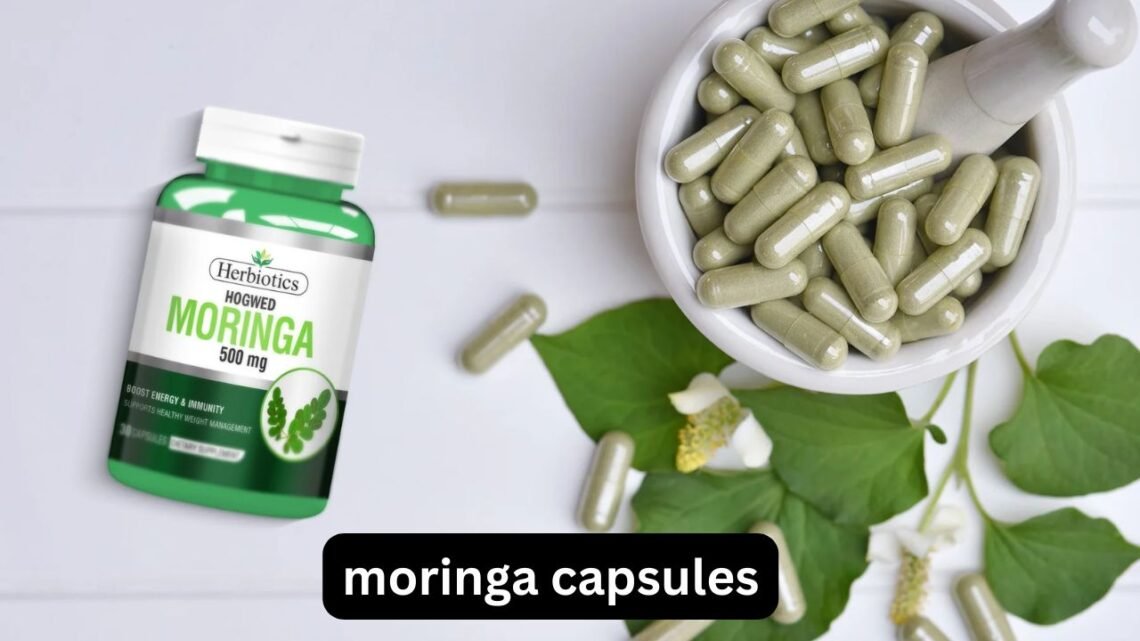
If you want an easy way to add moringa to your daily routine, capsules can seem like the obvious choice. There is no powder to mix, no strong green taste, and they are simple to take with a meal. But once you start comparing moringa capsules, the labels can become confusing: “pure moringa,” “organic moringa,” concentrated extracts, 500 mg capsules, and products promising energy, immunity or weight-loss support.
The important question is not simply whether moringa is “good for you.” It is what form you are taking, how much you are taking, and what you realistically expect it to do.
Moringa oleifera leaves contain plant compounds, vitamins and minerals, and human research is beginning to explore possible effects on blood sugar, blood pressure and antioxidant status. However, the evidence is still developing, and moringa should not be treated as a replacement for prescribed treatment.
This guide explains the potential moringa capsules benefits, sensible dosage, organic and pure options, UK products, safety considerations, and the mistakes that can make a seemingly simple supplement less useful.
What Are Moringa Capsules?
Moringa capsules are dietary supplements made primarily from the leaves of Moringa oleifera, a plant traditionally used as food and herbal medicine in parts of Asia and Africa.
The capsule may contain:
- Dried moringa leaf powder
- Moringa leaf extract
- A concentrated extract
- Organic moringa leaf
- A combination of powder and extract
This distinction matters.
A capsule labelled 500 mg moringa leaf powder is not automatically equivalent to a capsule containing 500 mg of a 10:1 extract. An extract can represent a much larger amount of the original plant material, depending on how it was produced.
For example, one current Holland & Barrett product lists 500 mg of a 10:1 moringa leaf extract and describes this as equivalent to 5,000 mg of pure leaf.
That is why comparing products purely by the number printed in milligrams can be misleading.
Moringa Capsules Benefits: What Does Research Say?
Moringa has attracted attention because its leaves contain polyphenols, flavonoids, glucosinolates and other plant compounds. Laboratory research has identified antioxidant and anti-inflammatory activity, but laboratory findings should not automatically be interpreted as proven health effects in people.
1. Antioxidant support
One of the most frequently discussed moringa capsules benefits is antioxidant activity.
Moringa leaves contain compounds that can participate in antioxidant processes. Human studies have investigated changes in antioxidant markers, although the strength and consistency of the evidence vary.
The practical takeaway is simple: moringa can be viewed as a nutrient-containing plant supplement, but it should not be marketed as a cure-all antioxidant treatment.
2. Possible support for blood sugar control
This is an area where moringa is being actively researched.
Recent reviews of human studies have reported potentially favourable effects on fasting glucose and HbA1c in some populations. However, researchers also highlight differences in doses, preparations, study populations and methodology. The evidence therefore remains preliminary rather than conclusive.
This distinction is especially important for someone already taking diabetes medication.
Moringa may potentially lower blood sugar, meaning combining it with glucose-lowering medication could require professional supervision.
3. Possible blood-pressure effects
Another interesting finding concerns blood pressure.
A 2026 meta-analysis of randomized controlled trials found reductions in systolic and diastolic blood pressure among participants taking moringa, but the authors noted that moringa did not significantly reduce body weight or BMI and that further research is needed.
A separate 2025 meta-analysis found only a modest diastolic blood-pressure effect and rated the overall certainty of evidence as very low because of methodological limitations and heterogeneity.
So it is more accurate to say moringa may influence blood pressure than to claim that moringa capsules are a proven treatment for hypertension.
4. Nutritional value
Pure leaf powder can provide naturally occurring nutrients, including iron, calcium and certain vitamins.
This is one reason some people use moringa as a nutritional supplement rather than expecting a dramatic therapeutic effect.
However, the nutritional contribution depends heavily on the product and serving size. A small capsule is not necessarily equivalent to eating a substantial quantity of moringa leaves.
5. Potential anti-inflammatory activity
Moringa contains several phytochemicals that have demonstrated anti-inflammatory activity in laboratory and experimental research.
Reviews of the research are promising but also point out a major problem: studies often use different preparations, doses and plant extracts. That makes it difficult to determine exactly how much benefit a typical commercial capsule provides.
This is an important distinction that is often missed: evidence that a compound in moringa affects an inflammatory pathway does not prove that a particular capsule will produce the same effect in a person.
Pure Moringa Capsules vs Moringa Extract
If you are choosing between pure moringa capsules and an extract, look beyond the front of the bottle.
Pure moringa leaf powder
Usually provides dried, powdered leaves.
Advantages:
- Simple ingredient profile
- Easy to understand
- Often suitable for people who want minimally processed moringa
- May provide naturally occurring plant nutrients
Potential drawback: the amount of active phytochemicals can vary between batches and products.
Moringa leaf extract
An extract is processed to concentrate particular components of the plant.
Advantages:
- Potentially higher concentration
- Smaller capsules can deliver more concentrated material
- Useful when a manufacturer has clearly standardised the extract
Potential drawback: “higher concentration” does not automatically mean “better.” It can make dose comparisons much more complicated.
A useful buying rule: don’t compare a 500 mg powder capsule directly with a 500 mg 10:1 extract and assume they contain the same amount of moringa.
Organic Moringa Capsules: Are They Better?
People searching for organic moringa capsules UK often assume organic automatically means more effective.
Not necessarily.
Organic certification primarily concerns how the agricultural product is produced and processed according to the applicable certification standards. It does not prove that the supplement will have a stronger clinical effect.
If organic production matters to you, look for:
- A clearly stated organic certification
- 100% moringa leaf when that is what you want
- A transparent ingredient list
- Batch or quality information where available
- Clear dosage instructions
For example, a current Holland & Barrett listing for Ayurvediq Organic Moringa Capsules states that the ingredient is 100% organic moringa, with a vegetable capsule shell.
Another H&B-listed product specifies 100% organic moringa leaf at 500 mg per capsule.
The key point is that organic describes production standards, not guaranteed health outcomes.
Moringa Capsules Dosage Per Day
There is no single universally established dosage of moringa capsules that applies to everyone.
This is one of the most important things to understand.
Different products can contain completely different forms and concentrations of moringa. Therefore, the manufacturer’s serving instructions matter.
For example:
- One H&B organic product recommends one capsule twice daily.
- Ayurvediq’s organic product gives a range of one to two capsules daily with food.
- Aduna’s product contains 500 mg organic moringa leaf powder per capsule and recommends a maximum of three capsules daily.
- A 500 mg 10:1 extract product recommends one to two capsules daily, illustrating why milligram numbers cannot be compared without looking at the extract ratio.
So how many moringa capsules should you take?
For a healthy adult considering a commercial supplement, the sensible approach is:
- Start with the manufacturer’s lowest recommended serving.
- Take it consistently rather than repeatedly increasing the dose.
- Take it with food if the label recommends this or if your stomach is sensitive.
- Never exceed the stated maximum without professional advice.
- Treat an extract differently from plain leaf powder.
There is no good reason to assume that taking more capsules will produce more benefits.
Holland and Barrett Moringa Capsules: What Should You Compare?
If you’re searching for moringa capsules Holland and Barrett, you may encounter several formulations rather than one universal H&B moringa product.
Current listings include:
- Whole-leaf moringa products
- Organic moringa capsules
- Moringa powder plus extract formulations
- Concentrated moringa extracts
- Third-party brands sold through H&B
For example, Holland & Barrett’s own 120-capsule product uses moringa powder and extract, while another product contains 500 mg of a 10:1 extract.
That means the best comparison is not simply “Which bottle contains the most capsules?”
Instead, compare:
| What to check | Why it matters |
|---|---|
| Moringa form | Powder and extract are different |
| Amount per serving | Shows how much you actually consume |
| Extract ratio | Helps interpret concentrated products |
| Ingredient list | Reveals fillers and additional ingredients |
| Organic certification | Relevant if organic sourcing matters to you |
| Recommended dose | Prevents accidental overuse |
| Warnings | Particularly important with medicines |
| Manufacturer information | Helps assess product transparency |
A Real-World Example: Choosing Between Two Bottles
Imagine you see two products.
Product A: 500 mg pure moringa leaf powder per capsule.
Product B: 500 mg 10:1 moringa leaf extract per capsule.
At first glance, both appear to contain “500 mg moringa.”
They don’t mean the same thing.
Product B is described as equivalent to 5,000 mg of the original leaf by its manufacturer.
This is one of the most useful details to check when shopping: look for whether the number represents raw leaf powder or an extract.
It prevents a common mistake where consumers choose a product solely because the milligram number looks larger.
When Is the Best Time to Take Moringa Capsules?
For most people, consistency is more important than a particular time of day.
Taking capsules with breakfast or lunch can be practical because it becomes part of an existing routine.
If moringa causes stomach discomfort when taken on an empty stomach, taking it with food may be more comfortable.
Some commercial products specifically recommend taking moringa with food. For example, H&B’s organic moringa listing recommends its capsules with food.
There is no strong evidence that taking moringa at exactly a particular hour produces superior health benefits.
Moringa Capsules Side Effects and Safety
“Moringa is natural” does not mean it is automatically suitable for everyone.
Potential problems can include digestive discomfort or individual intolerance. More importantly, moringa may interact with medications.
Holland & Barrett specifically warns that moringa extract may affect blood sugar, blood pressure, thyroid medication absorption and the way the liver processes certain medicines.
Be particularly cautious if you:
- Take diabetes medication
- Take blood-pressure medication
- Take thyroid medication such as levothyroxine
- Take several prescription medicines
- Are pregnant or breastfeeding
- Have a medical condition requiring regular treatment
If any of these apply, speak with a doctor or pharmacist before starting moringa.
Another important point: do not use moringa capsules to replace prescribed medication.
Can Moringa Capsules Help With Weight Loss?
This is one of the most common expectations—and one of the areas where marketing can run ahead of evidence.
Current research does not establish moringa capsules as a reliable weight-loss supplement.
The 2026 systematic review and meta-analysis found that moringa supplementation reduced blood-pressure measures but did not significantly change body weight or BMI.
So if your goal is fat loss, moringa should not be viewed as a shortcut.
A more realistic approach is to treat it as an optional nutritional supplement alongside a balanced diet, adequate protein, physical activity and sustainable calorie control.
Three Less-Obvious Things to Know About Moringa
1. “More moringa” isn’t automatically better
A concentrated extract can deliver substantially more equivalent leaf material than the same nominal milligram amount of powder.
This makes blindly increasing the number of capsules a poor strategy.
2. Research doses don’t automatically translate to commercial capsules
Some human studies use several grams of moringa preparations per day, while commercial capsules may contain hundreds of milligrams per capsule.
You therefore shouldn’t look at a study using grams of moringa and assume that taking a particular number of retail capsules will reproduce the same result.
3. The plant part matters
Research and traditional use can involve leaves, seeds, roots or other plant parts, but these are not interchangeable.
For everyday supplementation, products clearly identifying Moringa oleifera leaf are easier to evaluate than vague products simply labelled “moringa.”
This matters because safety profiles can differ between plant parts. Holland & Barrett, for example, specifically advises avoiding moringa roots because they contain a potentially toxic compound.
Common Mistakes People Make
Taking more because the supplement feels “natural”
Natural products can still have pharmacological effects and interactions.
Comparing products by capsule count
A bottle containing 180 capsules isn’t necessarily better than one containing 60. The serving size and formulation matter more.
Assuming organic means clinically proven
Organic certification does not establish that moringa prevents or treats a disease.
Expecting immediate results
Moringa is not comparable to a stimulant that produces an obvious immediate sensation. Nutritional supplementation should be judged realistically rather than by whether you “feel” something after one capsule.
Ignoring medications
This is arguably the most important mistake. If you take regular medication, checking compatibility is more important than choosing between two brands.
Is Moringa Worth Taking?
For someone who wants a convenient plant-based supplement, moringa capsules can be a reasonable option, particularly when the product has a transparent ingredient list and clearly states whether it contains leaf powder or an extract.
But expectations should remain realistic.
The strongest case for moringa is as a nutrient-containing plant supplement with promising—but still developing—research around metabolic and antioxidant effects. Recent human evidence is encouraging in some areas, while other reviews conclude that the overall certainty remains low.
If you’re choosing between products, focus less on impressive claims and more on form, dose, extract ratio, ingredients, certification and safety warnings.
FAQ
What are the main moringa capsules benefits?
Potential benefits being investigated include antioxidant activity, nutritional support and possible effects on blood sugar and blood pressure. Human research has produced promising findings, but it is not strong enough to consider moringa a proven treatment for these conditions. The benefits also depend on the preparation and dose used.
How many moringa capsules should I take per day?
There is no universal dose because products vary considerably. Current UK products give different instructions, ranging from one or two capsules daily to a maximum of three, depending on whether they contain leaf powder or concentrated extract. Always follow the specific product label rather than copying the dose from another moringa supplement.
Are organic moringa capsules better?
Organic moringa may be preferable if you specifically want organically produced ingredients, but organic certification does not mean the supplement has stronger proven health effects. Look for clear certification, a transparent ingredient list and an identifiable Moringa oleifera leaf ingredient. The actual formulation remains more important than the word “organic” alone.
Can you take moringa capsules every day?
Many commercial products are designed for daily use within their stated serving limits. However, daily use is not appropriate to assume for everyone, particularly people taking medication or those who are pregnant or breastfeeding. If you have a medical condition or use prescription medicines, check with a healthcare professional before taking moringa regularly.
Do moringa capsules help with weight loss?
There is currently insufficient evidence to recommend moringa capsules as a weight-loss treatment. A 2026 meta-analysis found no significant effect on body weight or BMI despite finding reductions in blood-pressure measurements. Moringa should therefore not replace proven nutrition and lifestyle strategies for weight management.
What should I look for in pure moringa capsules?
Look for Moringa oleifera leaf as the clearly identified ingredient, then check whether it is whole-leaf powder or an extract. Also check the amount per serving, extract ratio, recommended daily dose, capsule ingredients and safety warnings. A simple label that clearly explains what you’re actually getting is generally easier to evaluate than one built mainly around broad health claims.
Conclusion
Moringa capsules are convenient, plant-based supplements that can provide moringa leaf compounds and naturally occurring nutrients without the preparation associated with powders or teas.
The most sensible way to approach them is neither to dismiss them nor to treat them as a miracle supplement. Research suggests potential effects on areas such as antioxidant status, blood sugar and blood pressure, but important questions remain about dosage, standardisation and long-term effects.
When choosing pure moringa capsules, organic moringa capsules or a Holland & Barrett product, compare the actual formulation rather than the marketing headline. Most importantly, understand whether you’re buying ordinary leaf powder or a concentrated extract.
And if you’re taking medication, don’t assume that “natural” means interaction-free. A quick conversation with a pharmacist or doctor can be far more valuable than simply choosing the product with the highest number of milligrams.